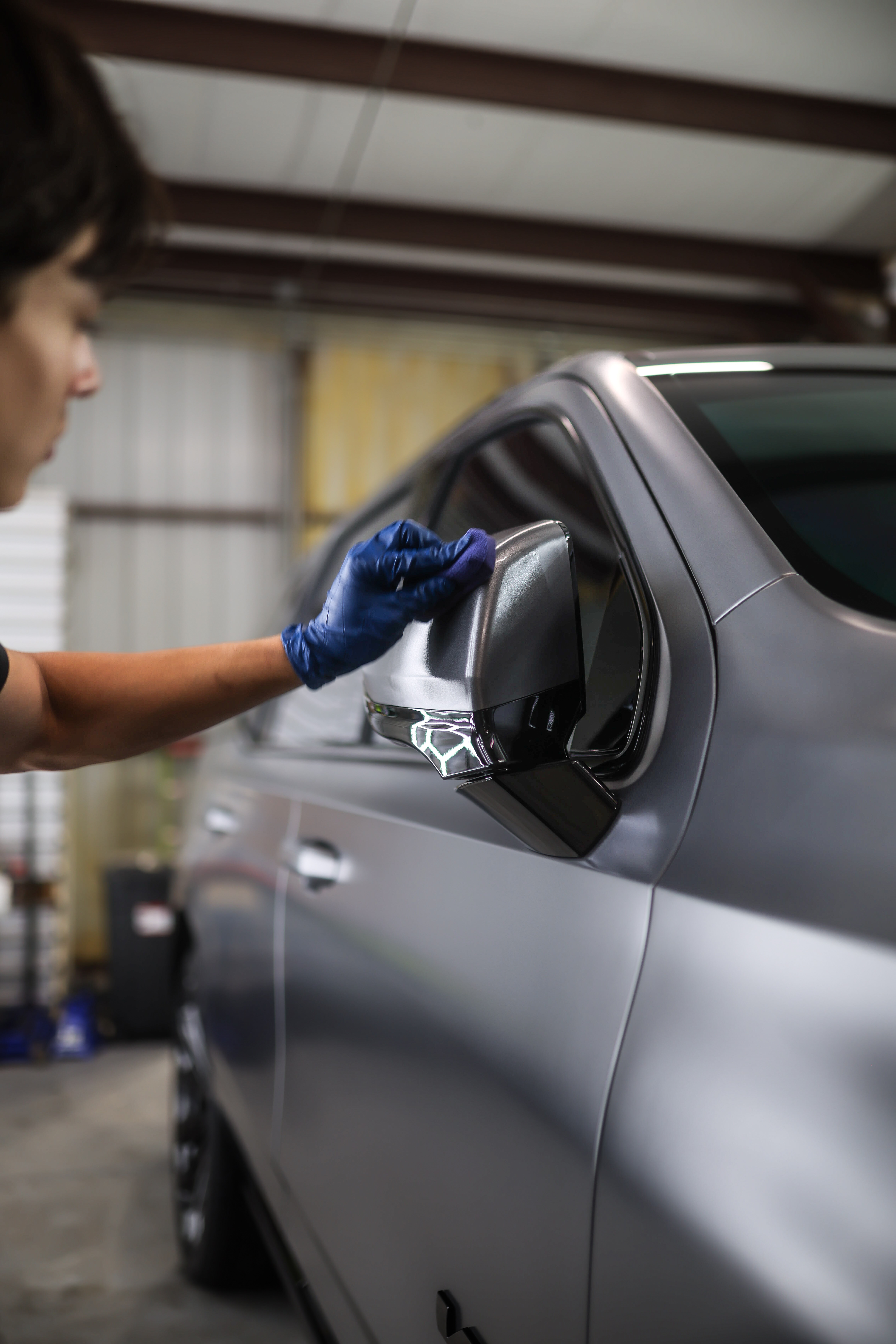
Buffer swirls and holograms look like straight parallel lines, not the random spiderweb that wash damage makes. They come from aggressive compounding that was never finished out to a refined surface. The critical part: holograms sealed under a ceramic coating are permanent, because the coating locks in whatever the paint looked like at application. Removal is typically a single-step finishing polish.
Here's a frustrating scenario that we see at Delicate Details regularly: a Lubbock vehicle owner pays for "paint correction" or machine polishing at a shop, gets their vehicle back, and notices the paint looks worse than before — or just different-bad. Instead of spiderweb swirls from washing, there are strange geometric patterns and streaks visible under direct light. These are buffer swirls, also called holograms — and they're caused by improper machine polishing technique. The irony is real: a service sold to fix paint damage has created new paint damage. The good news is that holograms are correctable, and this is exactly what proper finishing polishing addresses.
Buffer swirls are distinct from wash-induced swirl marks in their appearance. Regular swirl marks look like a random spiderweb pattern — chaotic, circular scratches radiating outward. Buffer swirls and holograms look more organized: you'll see repeating arc patterns, streak lines, or geometric "trails" that follow the movement path of whoever was running the polisher. Under direct halogen or LED correction lighting, holograms catch the light and show as bright, patterned reflections that shift as you move around the panel.
On black paint they're unmissable. On dark blue, silver, or white they're still visible under direct light. Most owners don't notice them indoors or in overcast conditions — they show up clearly in direct Texas sunlight, which is exactly when you least want your freshly "corrected" paint looking like this.
Holograms result from incorrect machine polishing execution — specifically, leaving aggressive abrasive scratches in the clear coat without finishing them out to a refined surface. The most common causes:
This is the critical issue: holograms sealed under ceramic coating are permanent. Ceramic coating bonds to the clear coat surface and locks in whatever condition the paint is in at application time. If the paint has holograms when the coating goes on, those holograms will be visible under the ceramic for the life of the coating — which for a quality 5-year or 10-year ceramic is a very long time. This is why proper paint inspection and finishing polish are non-negotiable steps before any ceramic coating application at Delicate Details. We inspect every panel under correction lighting before coating goes on, and we will flag and address any hologramming before proceeding.
Hologram removal is typically a Single-Step finishing polish process. We use a fine finishing compound on a DA orbital polisher with a soft finishing pad, working panel by panel at the correct speed and pressure. The DA's random orbital motion eliminates the directional patterns that caused the holograms in the first place, and the fine abrasive refines the clear coat surface to a uniform, clean finish that reflects light correctly.
On severe hologramming from an aggressive rotary cut, we may need a light compound pass first to remove the deeper scratches before finishing. After the finishing polish, we inspect under correction lighting to confirm the surface is clean — then and only then would we apply ceramic coating if that's the follow-up service.
| Service | Sedan | SUV | Truck |
|---|---|---|---|
| Enhancement (1-Step Light Polish) | $250 | $300 | $350 |
| Single-Step Correction | $350 | $400 | $450 |
| Two-Step Correction | $650 | $750 | $850 |
| Three-Step Correction | $850 | $950 | $1,100 |
Hologram removal from a previous bad polish job typically falls in the Single-Step to Two-Step range depending on severity. We'll assess under correction lighting and quote the appropriate stage — no guessing, no over-selling.
Delicate Details fixes buffer swirls and holograms in Lubbock TX. We inspect under correction lighting, use the right DA finishing sequence, and won't apply a single drop of ceramic coating until the paint is clean.
Book a Paint Correction →Swirl marks, light scratches, oxidation, water spot etching, and buffer trails — anything sitting within the clear coat. Scratches deep enough to catch a fingernail have usually gone through the clear and need paint, not polishing.
When thickness is measured first, yes. Clear coat is finite and varies across panels, especially on a repainted car. We measure before correcting and use the least aggressive approach that removes the defect.
Only from how the car gets washed. Correction removes them; automatic brush washes and dirty wash media put them straight back. Protection plus proper wash technique is what makes correction last.
Enhancement polish $250, single-step $350, two-step $650, three-step $850 on a sedan; trucks run up to $1,100 for a three-step. We measure paint thickness before any correction.