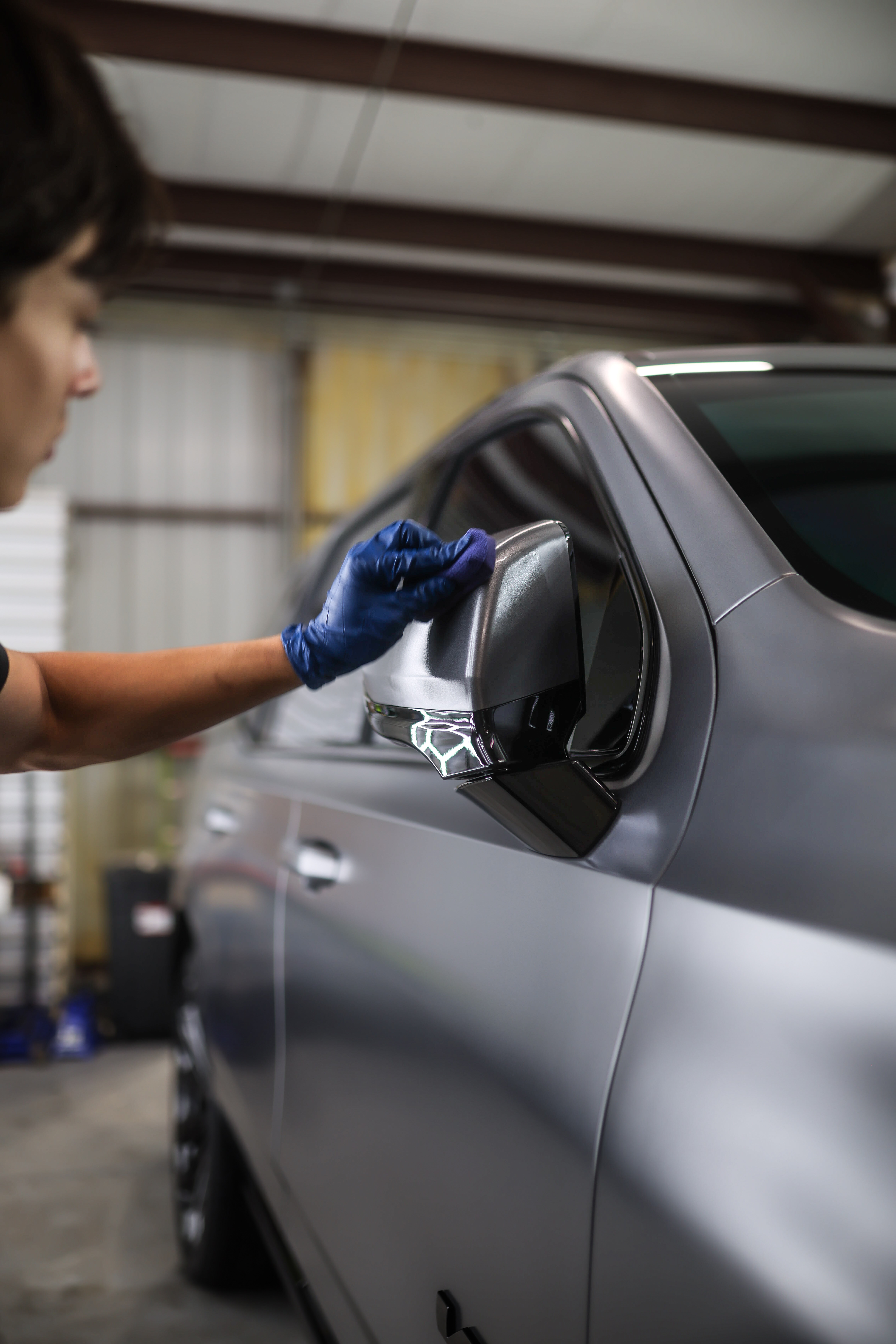
You're selling your truck. It's got 80,000 miles, runs well, and is mechanically solid. But after a few Lubbock summers parked outside, the paint is hazy, swirled, and looks rough in sunlight. The question: spend $650–$850 on a Two-Step paint correction to potentially get $1,500–$3,000 more on the private sale, or sell it as-is? For vehicles above a certain value threshold, the math is straightforward. For lower-value vehicles, it's not. This guide gives you the formula.
Used vehicle buyers — whether private party or dealers — respond to paint condition immediately and viscerally. Paint is the first thing anyone sees in listing photos and the first thing a buyer examines in person. Oxidized, swirled paint signals a vehicle that wasn't maintained. Even if the buyer doesn't know what "paint correction" is, they instinctively offer less because the vehicle looks worn out.
CarMax and dealership trade-in appraisers do this systematically. Their appraisal tools factor exterior condition into final offer, and "fair" paint condition versus "good" paint condition can mean $500–$2,000 difference on a truck appraisal depending on make and model. Private sale buyers use paint condition as their primary negotiating lever — a vehicle with rough paint gets beaten down in price far more than one that looks sharp.
In Lubbock specifically, where virtually every vehicle over 3 years old has accumulated UV and wash-induced paint damage, a corrected vehicle stands out dramatically from comparable listings. That differentiation has real dollar value.
For a 2020–2023 F-150, Silverado, Tacoma, or comparable SUV in the $20,000–$40,000 private sale range, a Two-Step correction plus a proper Stage 2 detail creates a listing that looks professionally maintained. The investment — typically $700–$900 for correction plus detail on a truck — routinely justifies $1,500–$3,000 improvement in final sale price. The return is 2x to 4x the investment. This is the clearest case for doing it.
A Single-Step correction ($350–$450 on a truck) on a $10,000–$12,000 vehicle with moderate paint damage can still produce $800–$1,500 in improved sale price. The math still works, though with a smaller margin. Skip the Three-Step and go Single-Step or Two-Step at most — over-investing in correction relative to vehicle value is the mistake to avoid here.
On a $3,000–$4,000 vehicle, buyers in this price range are not paying a premium for corrected paint. The math doesn't work — a $450 correction investment on a $3,500 car won't recover its cost in sale price. A basic detail ($195) to make it clean and presentable is the right call. Save the correction money.
The combination that produces the highest return per dollar invested:
Paint correction alone without a proper detail undersells the investment. Detail alone without paint correction on a visibly oxidized vehicle doesn't fix the core problem buyers notice. The combination is what shifts buyer perception from "this needs work" to "this was well maintained."
| Service | Sedan | SUV | Truck |
|---|---|---|---|
| Enhancement (1-Step Light Polish) | $250 | $300 | $350 |
| Single-Step Correction | $350 | $400 | $450 |
| Two-Step Correction | $650 | $750 | $850 |
| Three-Step Correction | $850 | $950 | $1,100 |
For pre-sale purposes, we typically recommend Single-Step or Two-Step rather than Three-Step unless the vehicle is high-value or black paint. The goal is dramatic visual improvement at an investment level that makes financial sense relative to sale price — not achieving show-car perfection.
Bring your truck, SUV, or car to Delicate Details in Lubbock TX and we'll recommend exactly what level of correction makes financial sense before your sale — honest advice, not an upsell.
Book a Paint Correction →