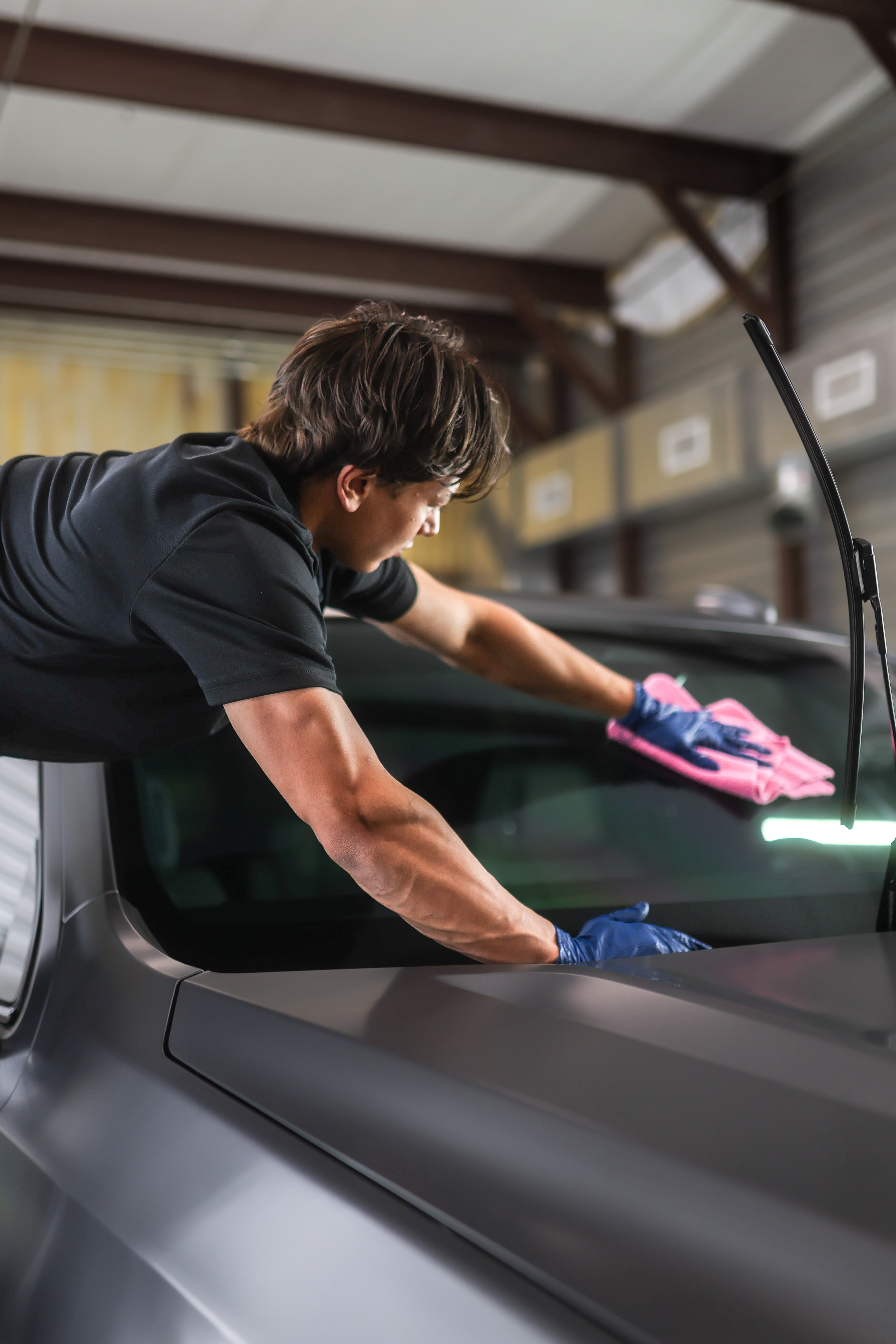
A ceramic coating is a liquid silica-based polymer that chemically bonds to your clear coat and cures into a hard, hydrophobic layer. It is not a wax and does not wash off — removing it requires machine polishing. It resists UV and makes contamination release more easily, but it does not prevent rock chips or deep scratches.
Ceramic coating is one of the most marketed — and most misunderstood — products in the automotive world. Walk into any auto parts store and you'll see spray-on "ceramic" products promising dealership-level protection for $30. That is not what we're talking about. Professional ceramic coating is a liquid polymer that chemically bonds to your vehicle's clear coat, forming a semi-permanent protective layer that can last 2 to 10 years depending on the product tier. This guide explains what it actually does, what it doesn't do, and why it makes particular sense in Lubbock TX's West Texas climate.
The silica matrix in a professional ceramic coating absorbs and deflects UV rays before they reach your clear coat. In Lubbock TX, where UV index regularly hits extreme levels and vehicles sit under an unforgiving West Texas sun, this is the single most valuable property the coating provides. UV is what causes oxidation — the chalky, hazy, dull appearance that plagues unprotected vehicles here after just a few years.
A properly cured ceramic coating dramatically reduces the surface energy of your paint, causing water to bead up and roll off rather than spreading and sitting. This property — called hydrophobicity — means rain and car wash water sheet off the panel instead of pooling, taking contaminants with it. In Lubbock's hard water environment, this matters: water that evaporates on paint leaves behind mineral deposits. Water that rolls off doesn't.
Bird droppings, bug splatter, and industrial fallout are acidic. On unprotected paint in Lubbock's heat, they can etch into the clear coat within hours. A ceramic coating provides a chemically resistant barrier that gives you time to clean these contaminants off before they do permanent damage.
A quality ceramic coating amplifies the light reflection of your paint — particularly on darker colors. The depth and gloss increase is visible and lasting, not a temporary shine that washes away.
Carnauba wax is the traditional paint protectant — and it has legitimate strengths. But in Lubbock specifically, wax has two critical limitations. First, wax lasts 4–8 weeks before degrading, which means you're reapplying multiple times per year. Second, wax melts. In Lubbock summers where pavement temperatures exceed 160°F and interior car temperatures exceed 180°F, wax degrades rapidly. A ceramic coating rated for 2, 5, or 10 years doesn't melt off your hood in August.
We install CarPro products — professional-grade formulations not available at retail. Our three tiers:
| Package | Durability | Starting Price |
|---|---|---|
| 2-Year Ceramic Coating | 2 years | $799 |
| 5-Year Ceramic Coating | 5 years | $1,299 |
| 10-Year Ceramic Coating | 10 years | $1,899 |
All packages include full decontamination prep — iron fallout removal, clay bar, and IPA wipe — before a single drop of coating touches your paint. Paint correction is quoted separately based on your paint's current condition. Every vehicle is inspected before we quote a final price. Call us at (806) 855-8042 or book online to get started.
Professional ceramic coating starting at $799. We use CarPro products — not retail-grade sprays. Serving Lubbock, Wolfforth, Slaton, Levelland, and the South Plains.
Book Your Detail →Rated life assumes reasonable care. In West Texas — 300-plus sunny days, caliche dust, and mineral-heavy water — a garaged vehicle washed properly will reach its rating, while one parked outside and run through brush washes will not. Maintenance is the variable, not the product.
No. Coatings are measured in microns and provide chemical and UV protection, not impact resistance. Rock chips and road debris are a paint protection film question, not a coating one.
Decontamination is mandatory, because a coating seals in whatever is underneath it for years. Correction depends on the paint — if there are swirls, they get locked in. We inspect under proper lighting and tell you what it needs.
Ceramic coating runs $799 (2-year), $1,299 (5-year) and $1,899 (10-year) on a sedan; $899/$1,399/$2,299 on an SUV; $1,099/$1,499/$2,599 on a truck or large SUV. Full decontamination and a one-step correction are included in every package.