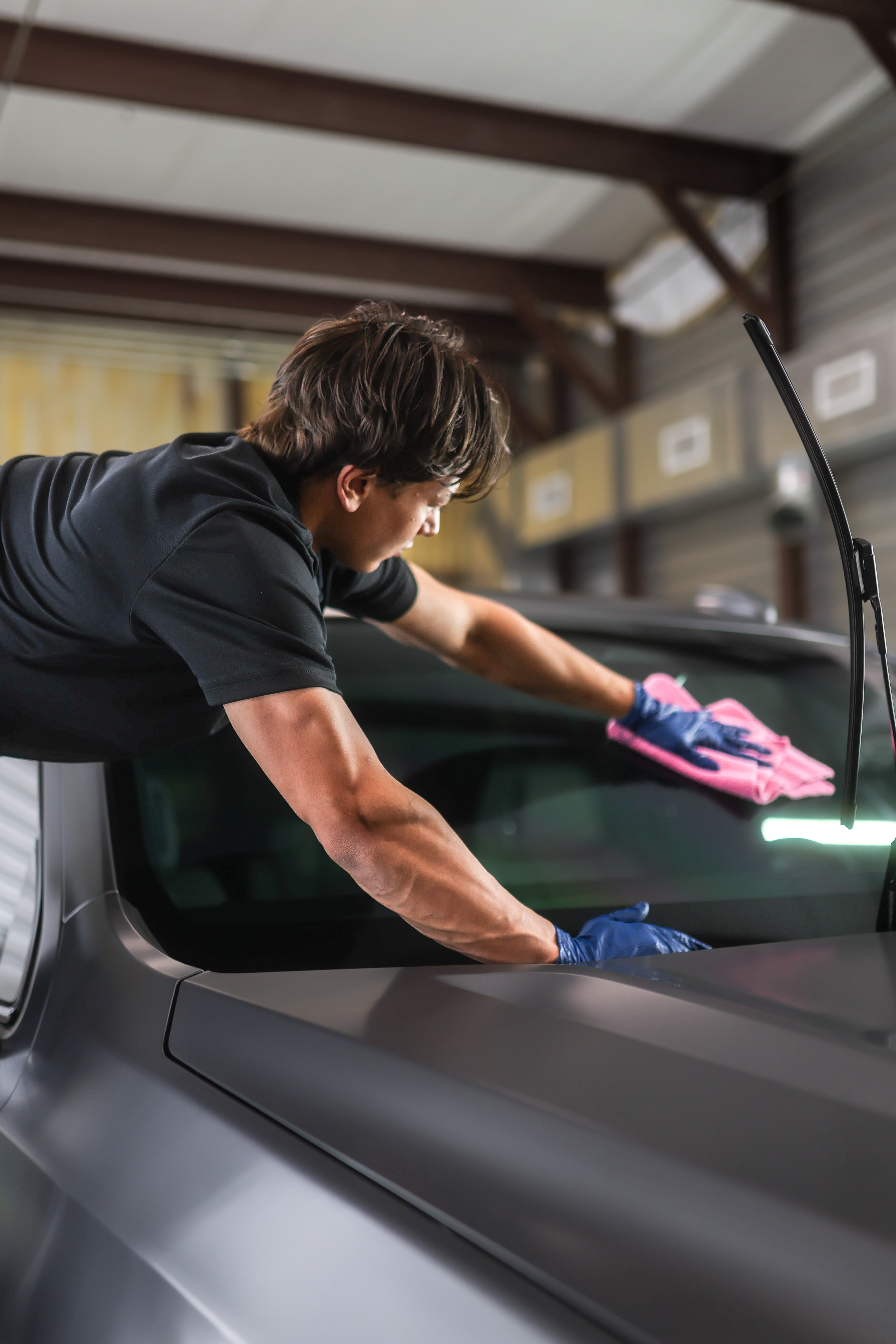
Carnauba wax is not a bad product; it is a product designed for conditions that do not exist in West Texas. It softens and breaks down in Lubbock summer heat, lasting roughly 4–6 weeks. Ceramic coating is SiO2 or SiC based, the same chemistry used in high-temperature industrial applications, so heat is simply not a failure mode for it.
Carnauba wax has been the standard car protection product for over a century. It comes from the leaves of the Brazilian carnauba palm, and when applied to automotive paint it produces a warm, deep, organic glow that enthusiasts have chased for generations. For a long time, it was simply the best option available — and in mild climates with moderate UV exposure and cool summers, it still has a place. Lubbock TX is not that climate. When you stack carnauba wax against ceramic coating in a West Texas environment, the comparison isn't close. This post explains exactly why — and what it means for how you protect your vehicle on the South Plains.
Carnauba wax is a natural product harvested from the leaves of the Copernicia prunifera palm, native to northeastern Brazil. The plant uses the wax as a protective coating to prevent moisture loss in its arid environment — which is an interesting parallel, since the vehicle protection industry adopted it for similar reasons. When refined and applied to automotive paint, carnauba wax creates a thin, glossy film over the clear coat that temporarily protects against light contamination and adds shine.
The key physical property that defines carnauba wax's limitations is its melting point: approximately 180°F (82°C). That sounds high until you know what West Texas does to vehicle surfaces in summer.
Lubbock's summer sun creates a specific temperature problem that makes carnauba wax fundamentally unsuitable as a primary protection product:
This is not a product quality issue — it's a physics issue. Even the finest Brazilian carnauba wax products, applied by skilled detailers with proper prep, cannot overcome a 180°F melt point in an environment that approaches that temperature regularly. You can reapply wax every 4–6 weeks if you choose, but that is an ongoing time and cost investment with a protection ceiling that ceramics simply don't have.
Ceramic coating is silicon dioxide (SiO2) or silicon carbide (SiC) based — the same materials used in high-temperature industrial applications. SiO2 ceramic coatings are rated to temperatures above 2,000°F. Heat is simply not a factor in ceramic coating degradation. A properly applied ceramic coating on a Lubbock vehicle is not affected by summer panel temperatures — at all.
Beyond heat resistance, ceramic coating forms a semi-permanent chemical bond with the clear coat's silica structure. It doesn't sit on top of the paint like wax — it becomes part of the surface layer. That bond is what gives ceramic coatings their 2–10 year durability ratings rather than weeks.
| Category | Carnauba Wax | Ceramic Coating |
|---|---|---|
| Aesthetic glow | Warm, deep, organic — slightly better subjectively | High gloss, wet-look shine — slightly cooler tone |
| Durability in Lubbock | 4–6 weeks maximum | 2–10 years |
| UV protection | Minimal — degrades rapidly | Strong — rated for long-term UV blocking |
| Hydrophobics | Moderate water beading | Aggressive water sheeting and beading |
| Chemical resistance | Low — bird droppings and tree sap etch through quickly | High — sacrificial layer resists chemical etching |
| Heat resistance | Melts at ~180°F | Stable above 2,000°F |
| Cost per year (Lubbock) | Higher — requires 8–13 applications per year | Lower — one-time application lasts years |
Wax wins on one metric — the warm aesthetic glow that carnauba produces is slightly more organic-looking than ceramic's high-gloss finish. If you're showing a concours vehicle on an overcast day, that matters. For daily driven vehicles in Lubbock, it doesn't. Ceramic wins every practical category decisively.
Carnauba wax has its place in the detailing world — it's not a bad product. It's simply a product designed for conditions that don't exist in West Texas. The South Plains' elevation, UV intensity, and summer heat create an environment where wax simply cannot maintain meaningful protection for a reasonable window of time.
If your goal is genuine paint protection for a Lubbock vehicle — UV blocking that actually persists through summer, hydrophobics that shed caliche mud and road grime, and a coating that doesn't require reapplication every month — ceramic coating is the only answer. Our ceramic packages at Delicate Details start at $799 for a 2-year coating and go up to $1,899 for a 10-year application. Call us at (806) 855-8042 to discuss which package fits your vehicle.
One ceramic coating application protects your paint for 2–10 years in West Texas conditions. No heat degradation. No monthly reapplication. Serving Lubbock, Wolfforth, Slaton, Levelland, and the South Plains.
Book Now →Rated life assumes reasonable care. In West Texas — 300-plus sunny days, caliche dust, and mineral-heavy water — a garaged vehicle washed properly will reach its rating, while one parked outside and run through brush washes will not. Maintenance is the variable, not the product.
No. Coatings are measured in microns and provide chemical and UV protection, not impact resistance. Rock chips and road debris are a paint protection film question, not a coating one.
Decontamination is mandatory, because a coating seals in whatever is underneath it for years. Correction depends on the paint — if there are swirls, they get locked in. We inspect under proper lighting and tell you what it needs.
Ceramic coating runs $799 (2-year), $1,299 (5-year) and $1,899 (10-year) on a sedan; $899/$1,399/$2,299 on an SUV; $1,099/$1,499/$2,599 on a truck or large SUV. Full decontamination and a one-step correction are included in every package.