Caliche is calcium carbonate rock dust, abrasive and alkaline, so wiping it off dry grinds it across your clear coat. Rinse thoroughly before any contact with the paint, every time. If the surface still feels gritty after washing, the caliche is embedded and needs iron decontamination plus clay to come out. A ceramic coating keeps particles from bonding in the first place.
Every vehicle owner in Lubbock TX knows the white dust. It coats your car after driving a county road, powders your hood after a west wind, and leaves a film on everything parked near a construction site or unpaved driveway. That white dust is caliche — calcium carbonate — and it is one of the most underestimated threats to car paint in the South Plains. Most Lubbock vehicle owners have no idea how much damage they're accumulating by handling caliche the wrong way. This post explains exactly what caliche does to clear coat and how to address it at each stage.
Caliche is a sedimentary rock layer of calcium carbonate that forms naturally just below the topsoil across West Texas and the South Plains. It's used as road base material on county roads and driveways across Lubbock County because it compacts hard when wet and is abundantly available. When vehicles drive on caliche roads, the mineral is pulverized into fine white dust that coats everything in its path.
As a dry dust, caliche is mildly abrasive — harder than automotive clear coat at the microscopic level. Here's where the damage pathway branches:
The correct caliche removal sequence prevents the scratch damage that casual wiping causes. Before any contact with the paint surface:
Skipping the foam pre-wash and going straight to contact washing is the source of most caliche scratching on Lubbock vehicles. The pre-wash step takes 5 minutes and prevents weeks of damage accumulation from being rubbed into the clear coat all at once.
If your vehicle's paint already has embedded caliche contamination — detectable by the rough, gritty feel of the paint surface when clean — the removal process requires two additional steps beyond washing:
Clay bar treatment is included in our Stage 2 Full Reset and Stage 3 Premium Detail packages, and is the critical decontamination step that most basic washes skip entirely.
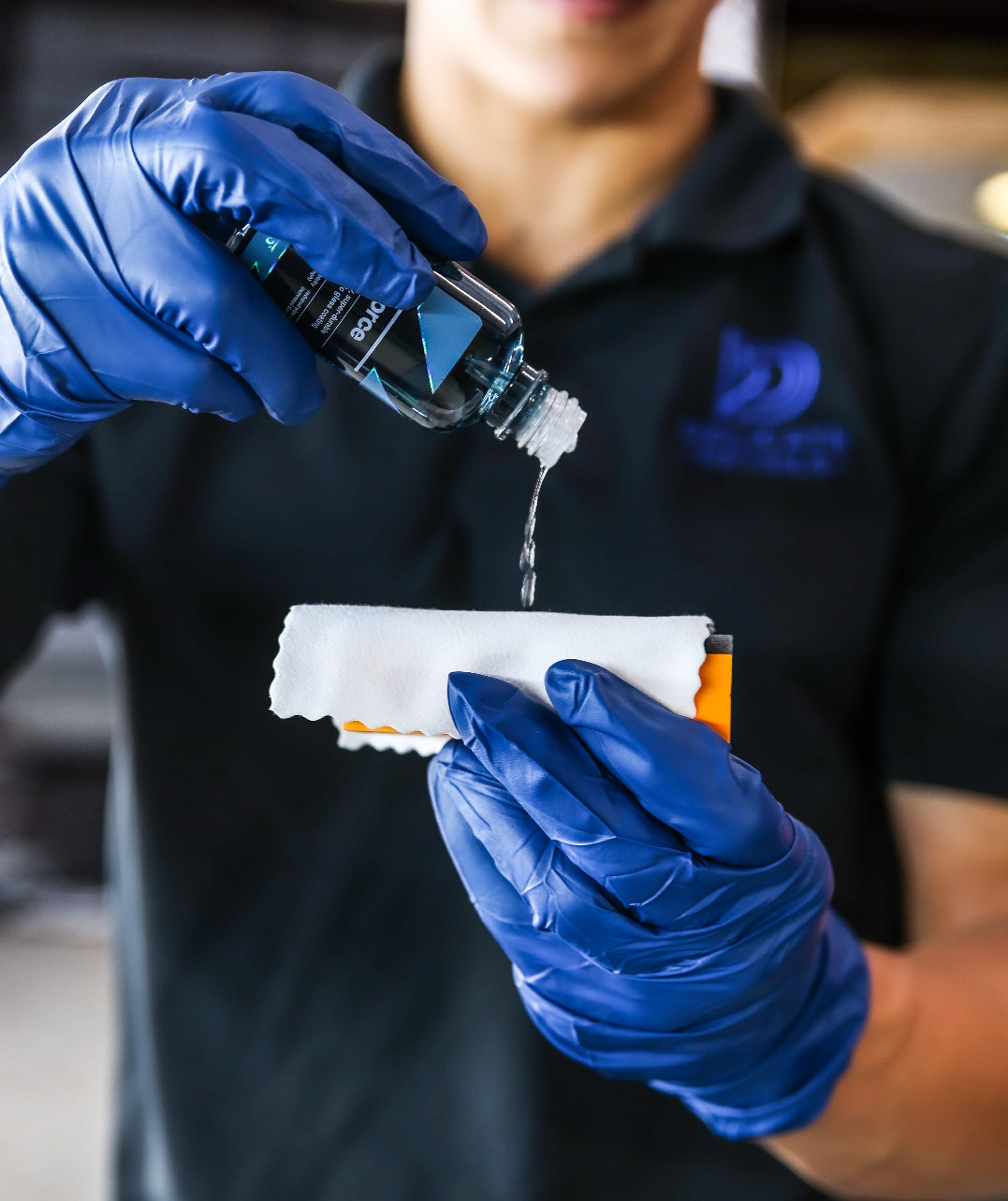
Ceramic coating changes the caliche equation significantly for Lubbock vehicles. The hydrophobic surface created by ceramic coating means caliche dust has a much harder time bonding to the paint — particles are more likely to bead and blow off or wash off easily rather than adhering. The chemical hardness of the ceramic layer also means that even if some caliche contact does occur during washing, it is contacting the ceramic coating rather than the clear coat directly.
After a ceramic coating installation, the maintenance routine for caliche becomes dramatically simpler: a foam pre-wash, a rinse, and a hand wash maintains the coating properly. The clay bar decontamination interval extends from every 6–12 months to every 12–18 months or longer depending on exposure level.
| Detail Package | Sedan | Midsize SUV/Truck | Full-Size Truck/SUV |
|---|---|---|---|
| Stage 1 — Essential Detail | $195 | $220 | $240 |
| Stage 2 — Full Reset & Protect (clay bar included) | $350 | $375 | $400 |
| Stage 3 — Premium Detail (clay bar + paint correction) | $695 | $795 | $895 |
If your paint currently feels rough or gritty after washing, start with Stage 2 to get the clay bar decontamination and ceramic sealant. If you can see haze or swirl marks from accumulated caliche micro-scratching, Stage 3 corrects that damage before the protection layer goes on. For long-term caliche defense, follow the Stage 2 or 3 detail with a full ceramic coating — call us at (806) 855-8042 to discuss the right sequence for your vehicle.
We decontaminate, correct, and protect Lubbock vehicles from caliche accumulation using the right products and the right process. Your paint deserves better than a gas station wipe-down.
Book Your Detail →Caliche is a calcium carbonate soil crust common across the South Plains. Airborne, it behaves as a fine abrasive, and it is alkaline — so it both scratches paint mechanically when wiped and attacks the finish chemically if left sitting.
Because wiping dry caliche across paint drags an abrasive across the clear coat. That single pass is where most West Texas swirl marks come from. Always rinse first so the grit floats off rather than being dragged.
Ogallala Aquifer water is high in calcium and magnesium. When a droplet evaporates on hot paint or glass, the water leaves and the minerals stay. On a hot surface they bond, and past that point they have etched rather than deposited.
Surface deposits come off with a dedicated mineral remover. Once they have etched into the clear coat, removal means machine polishing, and on glass it means cerium oxide polishing. Prevention — drying the vehicle rather than letting it air dry — is far cheaper than either.