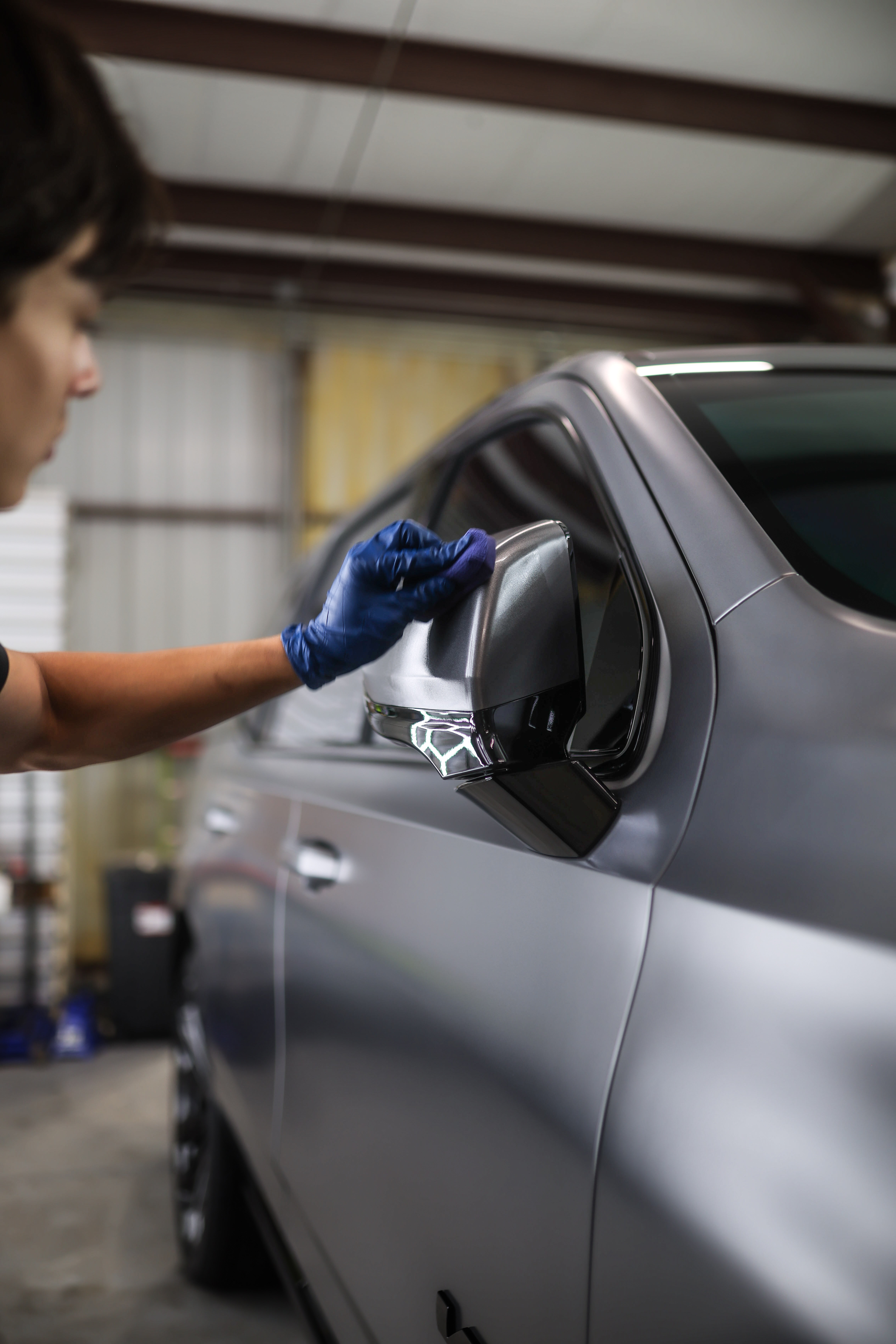
Buffer trails or holograms often appear as directional arcs or bands that move under direct light. Their cause and safe removability should be confirmed with inspection and a test area. A light polish may improve shallow trails, while deeper defects, thin paint, or damage beneath a coating may require a different plan.
Here's a frustrating scenario that we see at Delicate Details regularly: a Lubbock vehicle owner pays for "paint correction" or machine polishing at a shop, gets their vehicle back, and notices the paint looks worse than before — or just different-bad. Instead of spiderweb swirls from washing, there are strange geometric patterns and streaks visible under direct light. These are buffer swirls, also called holograms — and they're caused by improper machine polishing technique. The irony is real: a service sold to fix paint damage has created new paint damage. The good news is that holograms are correctable, and this is exactly what proper finishing polishing addresses.
Buffer swirls are distinct from wash-induced swirl marks in their appearance. Regular swirl marks look like a random spiderweb pattern — chaotic, circular scratches radiating outward. Buffer swirls and holograms look more organized: you'll see repeating arc patterns, streak lines, or geometric "trails" that follow the movement path of whoever was running the polisher. Under direct halogen or LED correction lighting, holograms catch the light and show as bright, patterned reflections that shift as you move around the panel.
On black paint they're unmissable. On dark blue, silver, or white they're still visible under direct light. Most owners don't notice them indoors or in overcast conditions — they show up clearly in direct Texas sunlight, which is exactly when you least want your freshly "corrected" paint looking like this.
Holograms result from incorrect machine polishing execution — specifically, leaving aggressive abrasive scratches in the clear coat without finishing them out to a refined surface. The most common causes:
A transparent coating does not hide existing holograms. If trails are visible before application, they may remain visible afterward. Correction beneath an existing coating can also disturb or remove that coating, so we inspect the finish, discuss prior work, test an appropriate area, and quote correction separately from protection. The goal is to make the condition and tradeoff clear before either service begins.
Some shallow trails improve with a light finishing step; others need more cutting and refinement. We choose the least aggressive process that produces a useful test-area result within the paint's safe limits. Machine type alone does not guarantee the finish.
When deeper scratches, prior repair, edges, thin paint, or an existing coating changes the risk, complete removal may not be the safe goal. We explain the expected improvement and any remaining defects before optional protection is applied.
| Service | Sedan | SUV | Truck |
|---|---|---|---|
| Enhancement (1-Step Light Polish) | $250 | $300 | $350 |
| Single-Step Correction | $350 | $400 | $450 |
| Two-Step Correction | $650 | $750 | $850 |
| Three-Step Correction | $850 | $950 | $1,100 |
Pricing depends on vehicle size, paint condition, prior repairs or coatings, and the safe scope confirmed by inspection. We quote the appropriate stage after viewing the vehicle rather than promising a fixed process from photos alone.
Delicate Details assesses buffer trails and holograms in Lubbock TX. We inspect the finish, test the proposed process, and explain realistic improvement before correction or optional protection.
Book a Paint Correction →Paint correction may improve suitable swirl marks, shallow scratches, oxidation haze, some water-spot etching, and buffer trails within healthy clear coat. A fingernail check can provide context but does not prove depth or safe removability; inspection, paint history, and a test area determine whether polishing, touch-up, or body repair is appropriate.
It can be when the paint is inspected, the intended improvement is realistic, and enough healthy material remains. Total paint-thickness readings do not isolate the clear-coat layer by themselves, so we also consider panel history, visual inspection, and test areas before choosing the least aggressive useful process.
New swirl marks can develop from brush washes, dirty wash media, dry wiping, or other abrasive contact. Correction improves existing suitable defects but does not prevent new ones; careful washing and compatible protection can help preserve the finish.
Published sedan prices are $250 for enhancement, $350 for single-step, $650 for two-step, and $850 for three-step correction; the listed truck price reaches $1,100 for three-step. Vehicle condition, prior repairs, size, and the safe scope confirmed after inspection can change the quote.