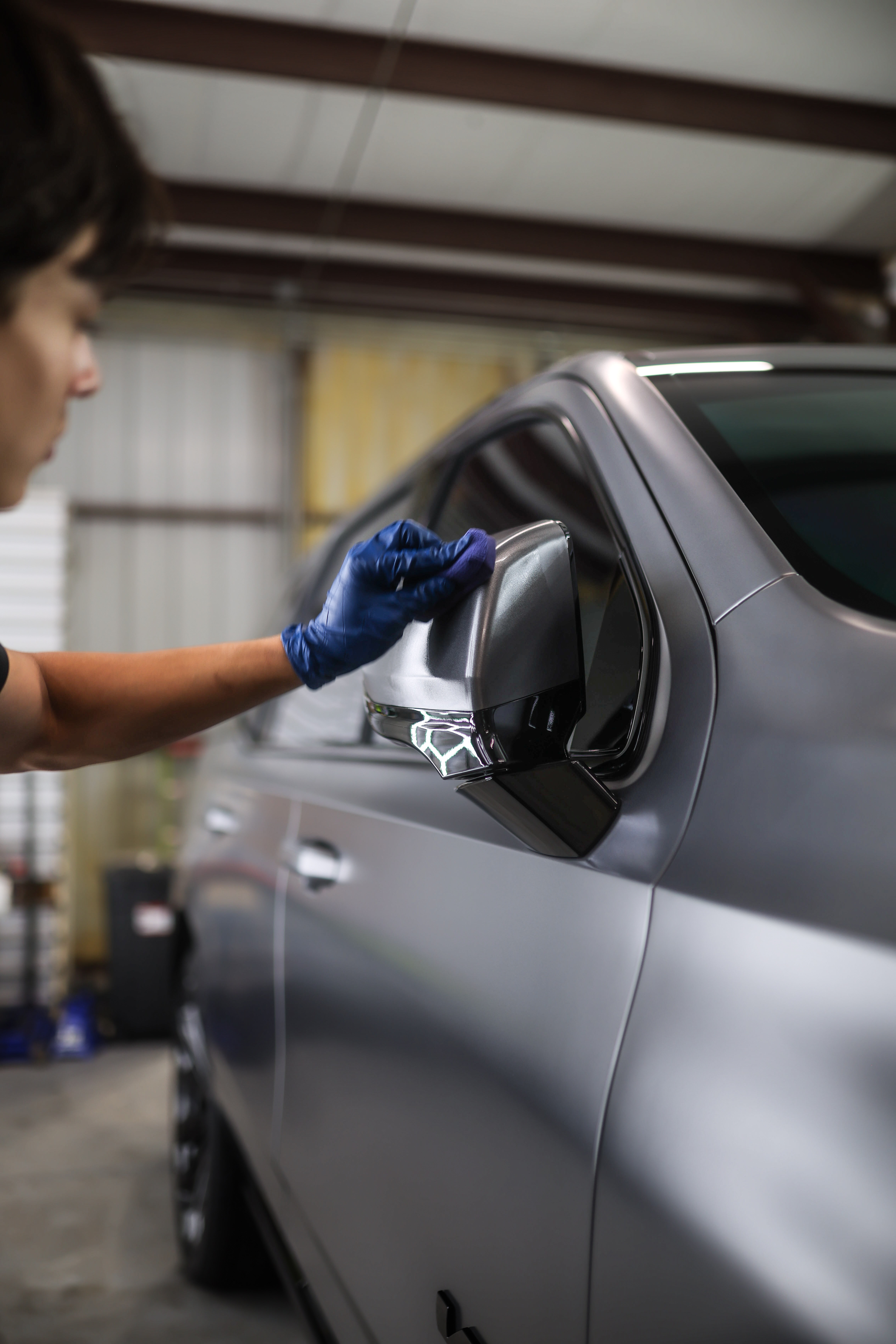
Swirl marks are fine paint defects commonly created when contamination is moved across the finish during washing, drying, or dry wiping. Brush washes, dirty wash media, and contact with caliche dust can contribute. Machine polishing may improve suitable defects after inspection; careful washing and compatible protection can reduce future abrasive contact but cannot prevent new marks.
Swirl marks are a common paint concern for Lubbock vehicle owners. They are fine defects in the upper finish that become easier to see when direct light reflects from their edges. Caliche dust, brush washes, dirty wash media, and dry wiping can all create or add to them; the rate of damage depends on contamination, contact pressure, materials, paint condition, and wash history.
Many modern painted panels use a primer, color coat, and clear coat over steel, aluminum, plastic, or another substrate. The transparent clear coat contributes gloss and protects the color layer. What people call swirl marks are usually fine defects in that upper finish; deeper scratches, repainted panels, matte finishes, and failing clear coat require different evaluation.
Fine defects can be difficult to see under diffuse indoor lighting and more visible under a direct inspection light or low-angle sun. Dark colors often make the contrast easier to notice, while lighter colors may hide some marks from casual viewing. Visibility still depends on defect depth, paint color, lighting, and viewing angle.
Preventing swirl marks in Lubbock TX requires changing how you interact with your paint:
Some glazes, waxes, and sealants can temporarily reduce the appearance of fine defects without removing them. Machine paint correction uses abrasives to improve suitable defects by removing a small amount of the upper finish. Because clear coat is finite and total paint-thickness readings do not isolate it by themselves, inspection, panel history, lighting, and a test area should guide the least aggressive useful process.
At Delicate Details, the correction scope is selected after inspection and a test area. Published sedan starting prices are:
No coating makes corrected paint swirl-proof. A compatible coating or sealant can change water behavior and make some contamination easier to remove, but abrasive contact can still mark the coating and paint system. Careful washing, clean media, and prompt contamination removal remain necessary.
Swirl marks often trace back to contaminated wash media, brush contact, dry wiping, or improper polishing. Prevention means reducing abrasive contact. Existing defects may improve with paint correction when the finish is healthy enough, while deep scratches, thin or failing clear coat, matte finishes, and some repainted panels may require a different plan or may not be suitable for correction.
See swirl marks on your car? Call Delicate Details at (806) 855-8042 or request a quote below. We will inspect the paint, discuss the improvement you want, and explain which correction scope is appropriate—or when polishing is not the right answer.
We inspect the finish, explain realistic improvement and limits, and quote the least aggressive useful correction scope. Located in Lubbock TX, serving the South Plains.
Book Now →Paint correction may improve suitable swirl marks, shallow scratches, oxidation haze, some water-spot etching, and buffer trails within healthy clear coat. A fingernail check can provide context but does not prove depth or safe removability; inspection, paint history, and a test area determine whether polishing, touch-up, or body repair is appropriate.
It can be when the paint is inspected, the intended improvement is realistic, and enough healthy material remains. Total paint-thickness readings do not isolate the clear-coat layer by themselves, so we also consider panel history, visual inspection, and test areas before choosing the least aggressive useful process.
New swirl marks can develop from brush washes, dirty wash media, dry wiping, or other abrasive contact. Correction improves existing suitable defects but does not prevent new ones; careful washing and compatible protection can help preserve the finish.
Published sedan prices are $250 for enhancement, $350 for single-step, $650 for two-step, and $850 for three-step correction; the listed truck price reaches $1,100 for three-step. Vehicle condition, prior repairs, size, and the safe scope confirmed after inspection can change the quote.