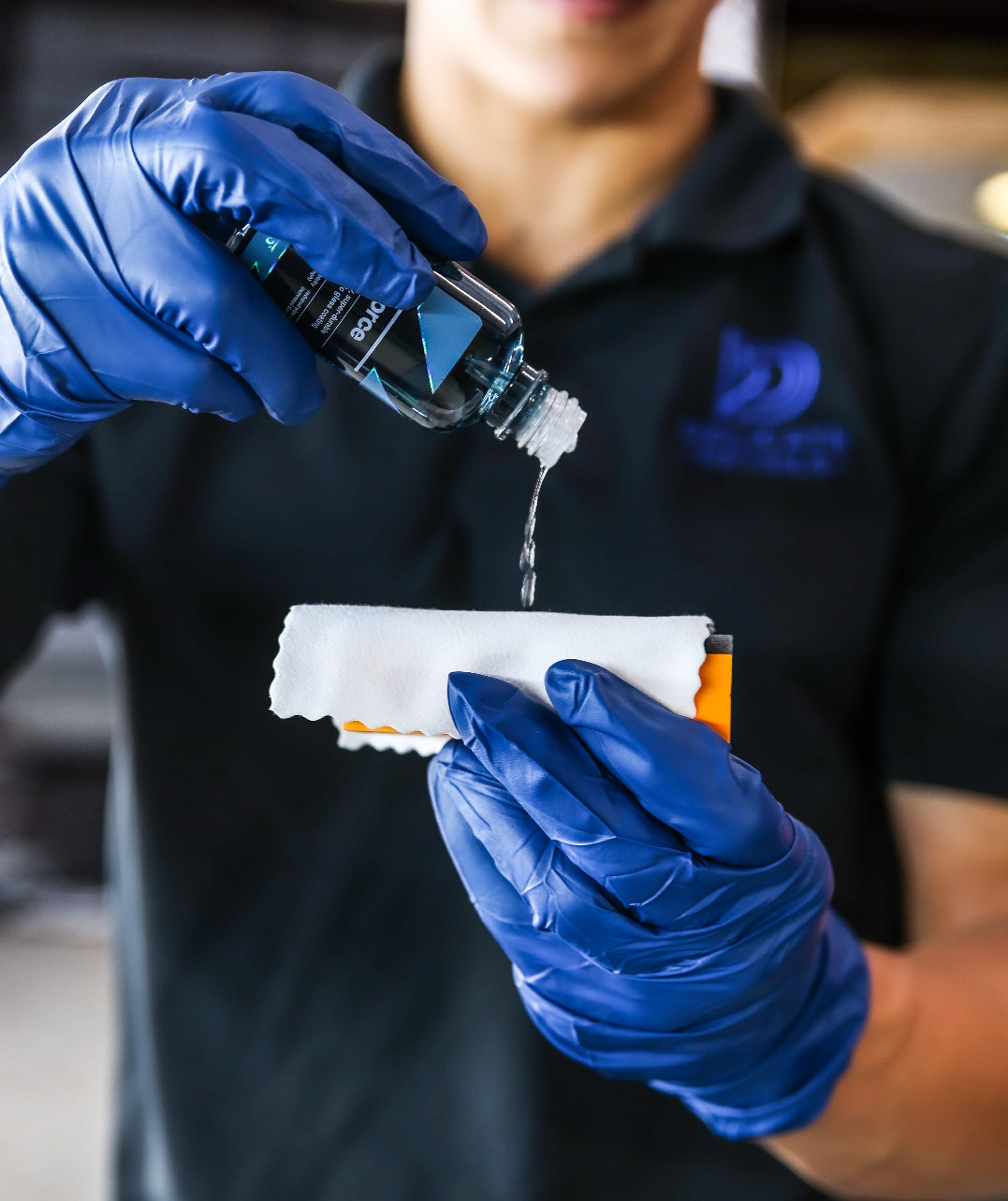
Fabric guard bonds to whatever is on the fiber surface: so applied over a dirty seat it seals the contamination in and makes things worse. Clean first, protect after, always. On leather the prevention strategy is different: well-conditioned leather resists absorption in a way dry, cracked leather cannot. Both are included in Full Reset & Protect and Premium.
The best seat stain to deal with is the one that never happens. Prevention — applied correctly after a professional clean — is dramatically more cost-effective than restoration after years of unprotected use. Car seat stain prevention in Lubbock TX means two things: fabric guard on cloth seats and conditioning on leather seats. Both create a barrier that changes how the seat surface interacts with spills. This guide explains exactly how each works, why the product you buy at the store is not the same as what professionals apply, and which Lubbock vehicle owners benefit most from making prevention a regular part of their maintenance routine.
Fabric protection sprays — when applied correctly to clean fabric — bond to the individual fibers at a molecular level and change their surface energy. This is the technical term for what makes a treated surface hydrophobic: water and water-based liquids can no longer spread across or into the fiber surface because the surface energy is too low for the liquid to wet it. Instead, the liquid beads into droplets and sits on top of the fabric.
The practical result: a coffee spill on an unprotected fabric seat absorbs into the fibers in 3–5 seconds. On a fabric-guard-treated seat, that same spill beads on the surface for 30–60 seconds. In those 30–60 seconds, a napkin or cloth can blot up 90% of the spill before it penetrates. That is the entire value proposition — it does not make seats invincible, it gives you time to react.
Fabric guard does not change how the seat looks or feels. When applied correctly at professional dilution, the surface feels identical to untreated fabric. There is no stiffness, no sheen, no perceptible difference — only the liquid-beading behavior reveals that protection has been applied. Over-application — soaking the seat with too much product — causes stiffness and can affect fabric breathability. This is the most common DIY application mistake.
This distinction matters more for fabric protection than for almost any other detailing product category. The gap between what you buy at AutoZone or Walmart and what professionals apply is significant in both chemistry and longevity.
Standard consumer fabric protectors use older fluoropolymer chemistry or newer water-based formulations that are easier to manufacture and safer to sell to the general public. They work — for a while. In Lubbock TX's combination of high UV exposure, extreme heat cycles, and dry conditions that accelerate chemical breakdown, consumer fabric protection typically degrades to ineffective levels within 4–8 weeks. By the end of a Lubbock summer, a Scotchgard application from April provides essentially no meaningful protection.
Professional-grade fabric protection products use higher-performance fluoropolymer formulations that bond more durably to fabric fibers and resist UV degradation more effectively. In Lubbock conditions, professional-grade application maintains meaningful hydrophobic protection for 4–6 months — roughly ten times longer than consumer products under the same conditions. For vehicles kept in a garage and out of direct sun, that window extends further.
The other key difference is application control. Professional products are applied at calibrated dilutions with even coverage across all seat surfaces — cushions, seat backs, headrests, and side bolsters. Consumer sprays applied by hand almost always over-saturate some areas and miss others, resulting in uneven protection that fails inconsistently.
For leather seats, the stain prevention strategy is different. Leather with a healthy, supple, well-conditioned surface has a natural resistance to spill absorption that dry, cracked leather does not. The surface coating on new or well-maintained leather is largely intact — spills sit on the surface coating rather than penetrating into the leather fiber beneath. Dry, neglected leather has a compromised surface coating with micro-cracks throughout, and liquids penetrate these cracks directly into the fiber structure where they stain and are difficult to remove.
In Lubbock TX, where 100°F+ ambient temperatures push interior cabin temps to 130–150°F and desiccate leather rapidly, conditioning every 3–6 months is the primary stain prevention strategy for leather seats. Conditioned leather does not stain as readily as dry leather. Conditioning also maintains the surface coating integrity that keeps liquids on top of the seat rather than inside it.
For leather seats that need enhanced protection beyond conditioning, ceramic coating for leather surfaces provides a durable hydrophobic layer that makes spills bead and wipe off cleanly — similar to ceramic coating on paint. This is particularly valuable for lighter-colored leather (tan, beige, white) that shows staining most visibly.
Fabric protection and conditioning make sense for every vehicle, but some Lubbock owners get disproportionate value from it:
Fabric protection applied over a dirty seat does not work correctly — and can make the situation worse. Fabric guard bonds to whatever is on the surface of the fiber. If that surface has existing contamination — body oil, dust, old spill residue — the protection bonds to the contamination layer rather than the fiber itself. The result is a protection layer with poor adhesion that fails quickly and locks in the existing grime underneath.
This is why fabric protection at Delicate Details is always applied after thorough cleaning and extraction — never on top of an uncleaned surface. The seat must be completely clean and dry before any protection product goes on. This is the sequence that makes protection last.
Fabric guard on cloth seats and leather conditioning on leather seats are both included in Stage 2 and Stage 3 details. They are applied after cleaning as the final step of the interior service — not as standalone treatments, because proper surface preparation must precede protection.
| Package | Prevention Applied | Sedan | Mid-Size | SUV / Truck |
|---|---|---|---|---|
| Stage 1 — Essential Detail | Surface clean only, no protection layer | $195 | $220 | $240 |
| Stage 2 — Full Reset & Protect | Professional fabric guard on cloth, leather conditioning on leather, UV protectant on plastics | $350 | $375 | $400 |
| Stage 3 — Premium Detail | Everything in Stage 2 plus machine paint correction | $695 | $795 | $895 |
If you have a new vehicle, a recently purchased used vehicle, or a family hauler that takes daily punishment in Lubbock TX, Stage 2 gives you clean seats with professional protection applied correctly on top. Call (806) 855-8042 or book below. Protection is always cheaper than restoration.
Delicate Details applies professional-grade fabric guard and leather conditioning on every detail — clean first, protect after. Serving Lubbock, Wolfforth, Slaton, Levelland, and the South Plains.
Book Your Detail →Often, but not always. Fresh contamination extracts well. Anything that soaked into the foam or carpet backing and sat — especially through West Texas heat — may be permanent. We assess and tell you before you commit.
Cleaning solution is injected into the fabric or carpet and pulled straight back out under vacuum. That removes contamination from the material rather than pushing it deeper, which is what surface scrubbing does.
A thorough interior is most of a day. Heavy pet hair, stain extraction, or odour work adds hours — those are quoted as add-ons before we start rather than discovered afterward.
Stage 1 Essential is $195, Stage 2 Full Reset & Protect is $350, Stage 3 Premium is $695 — sedan pricing, with SUVs and trucks priced by size.