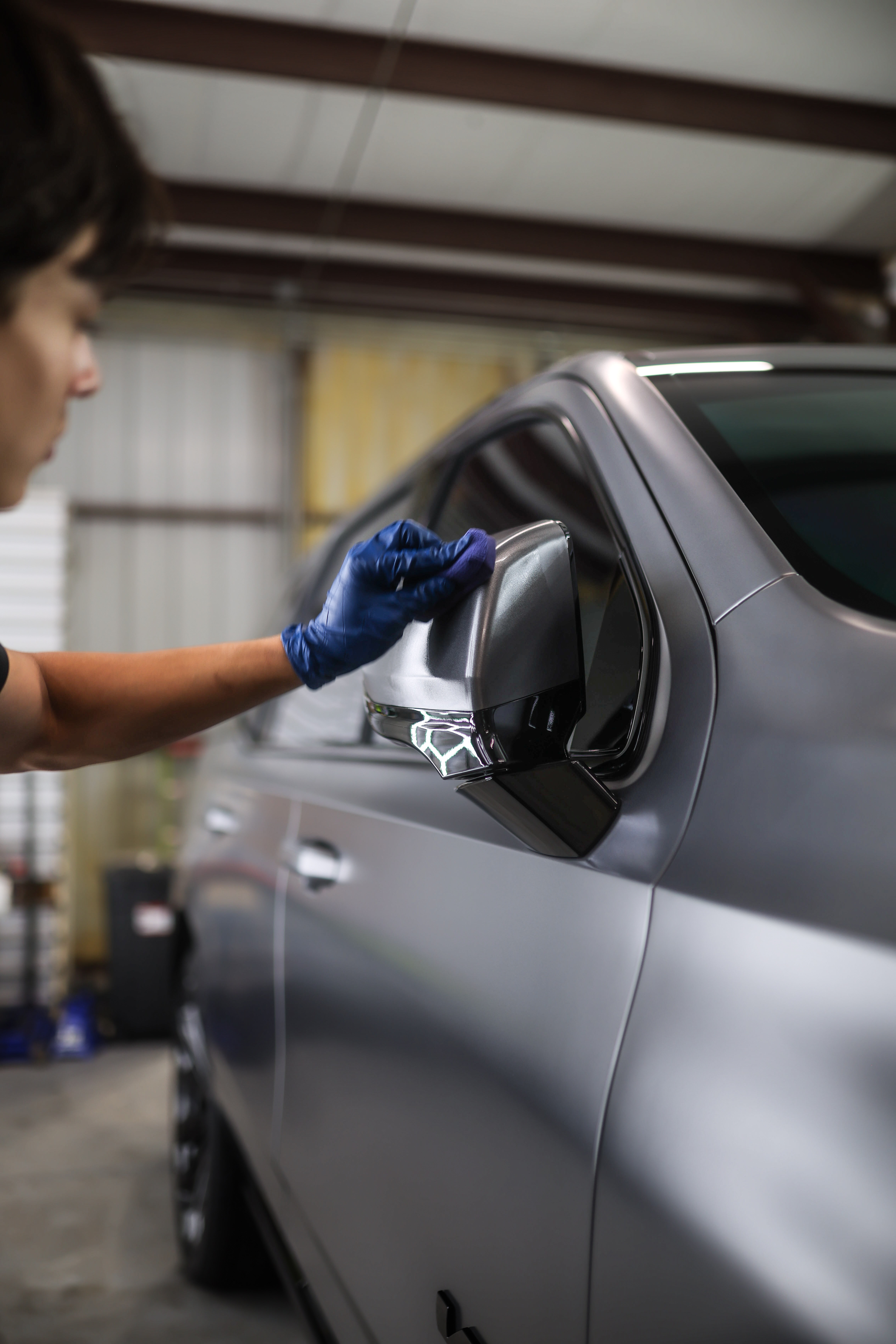
Contact car washes can contribute to swirl-like marring when wash media carries contamination or the paint is already vulnerable. Touchless systems avoid brush contact, but their chemistry, pressure, and drying performance vary. Inspect the paint before assigning one cause or choosing correction.
If the paint shows a web of fine marks under direct light, repeated contact washing may be one contributor. The pattern alone cannot prove the source: prior hand washing, drying, dusting, dealership preparation, repair work, and other contact can create similar marring. Start with inspection rather than assuming every automatic wash or every visible defect has the same cause.
A contact car wash uses rotating or moving foam, cloth, or synthetic media with water and detergent. Whether that contact leaves visible marring depends on the media condition, retained contamination, lubrication, pressure, paint hardness and condition, previous repairs, and the wash system's maintenance.
Lubbock vehicles commonly arrive with windblown dust and road soil. If contamination remains in contact media or on the vehicle, moving it across the finish can increase the chance of fine marks. That does not mean every system is maintained the same way or every visit produces visible damage.
Swirl-like marks are fine clear-coat defects that become easier to see around a point light. Contact washing can contribute, but the apparent circular pattern often reflects how the light reveals scratches from many directions rather than proving one rotating brush created them.
Labels such as “soft cloth” do not answer every risk question. A well-maintained contact system and a neglected one are not equivalent, and paint with chips, failing clear coat, loose trim, or fresh repairs may need different care from intact factory paint.
Windblown dust and road soil are common reasons to prioritize a thorough pre-rinse before any contact step. Visible contamination should be loosened and carried away before wash media moves across the paint.
Storage, driving environment, wash frequency, prior repair, paint behavior, drying technique, and protection all affect condition. Delicate Details can document the finish present at inspection, but a shop visit cannot reliably reconstruct every wash event or compare it with an identical vehicle in another climate.
Fine paint defects may be difficult to see in overcast or diffuse light. To inspect the finish without claiming a cause:
Visible marring does not automatically require a specific correction stage. Paint history, defect depth, coating or film, total paint-thickness context, and a test area all help determine whether polishing is useful and safe.
The action plan is straightforward:
| Detail Package | Sedan | Mid-Size SUV | Full-Size SUV/Truck |
|---|---|---|---|
| Essential Detail | $195 | $220 | $240 |
| Full Reset & Protect | $350 | $375 | $400 |
| Premium Detail | $695 | $795 | $895 |
Premium Detail includes inspection-based machine correction for suitable clear-coat defects within its listed scope. Dedicated paint correction is quoted separately, with published sedan pricing from $350 for a single-step service. Vehicle size, condition, prior repairs, and the safe scope confirmed after inspection can change the quote. Call (806) 855-8042 or request an inspection-based quote below.
Delicate Details evaluates visible defects, explains realistic improvement and limits, and recommends only the preparation, polishing, or protection supported by the paint condition.
Book Your Detail →Pre-rinse loose soil, use clean and well-lubricated wash media, keep wheel tools separate, and dry with clean microfiber using minimal pressure. Follow the vehicle and protection-product instructions.
No universal result applies. Contact-system risk depends on media cleanliness, lubrication, maintenance, paint condition, and prior repairs. Touchless systems avoid brush contact, but chemistry, pressure, and drying performance vary.
There is no fixed schedule for every vehicle. Storage, mileage, contamination, wash habits, weather exposure, protection type, and owner expectations determine when inspection or maintenance is useful.
Not from the pattern alone. Brush contact can contribute to marring, but prior washing, drying, dusting, repair work, and other contact may produce similar defects. Inspection can document condition without proving one source.