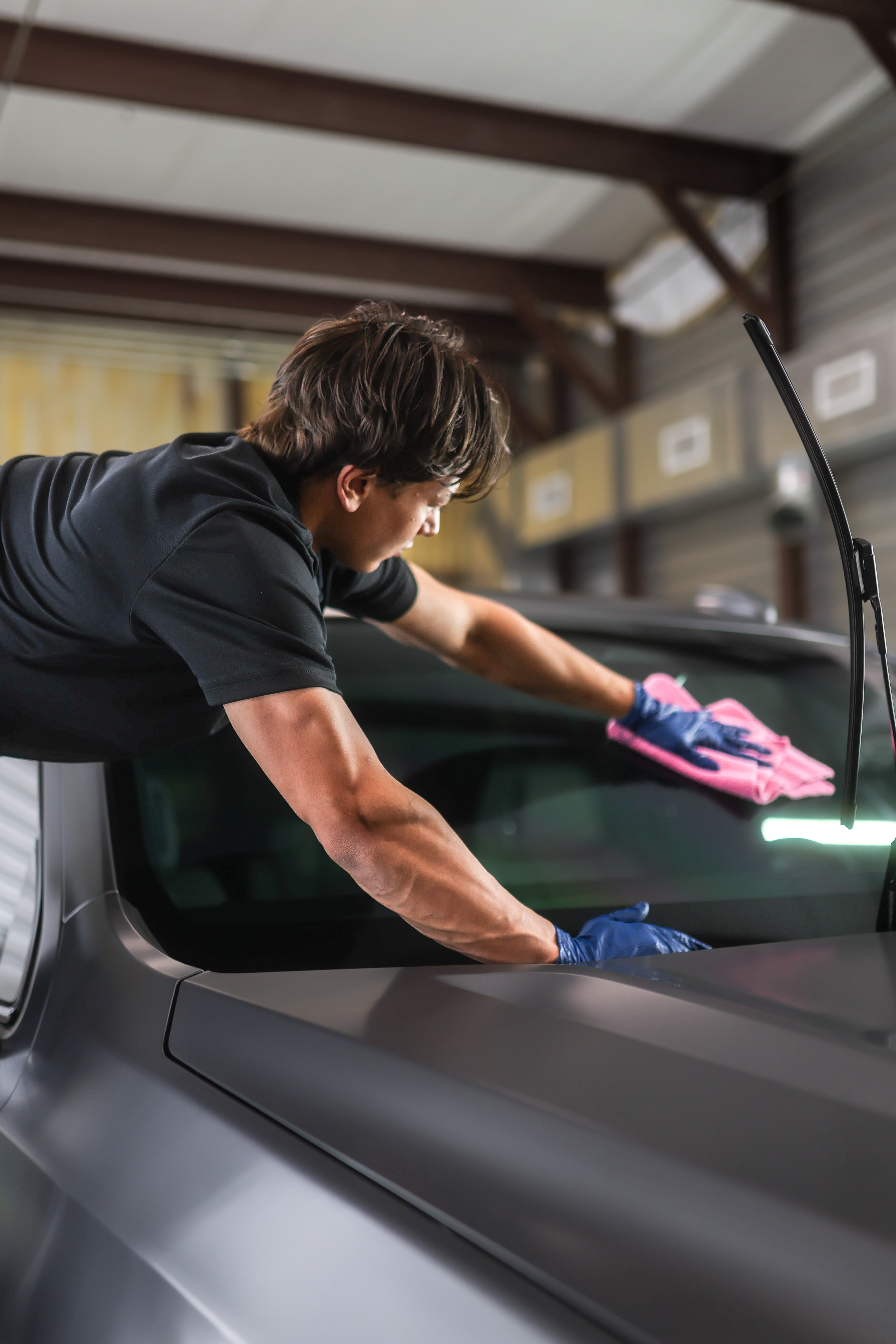
Ceramic coating is silicon dioxide that forms a covalent bond with your clear coat as it cures: not a layer sitting on top of it. The cured silica matrix absorbs UV before it reaches the paint, and its microstructure is what makes water bead and roll off. Any wax, polishing oil, or contamination between the SiO2 and the clear coat blocks that bond.
If you've read our intro guide on what ceramic coating is, this post goes deeper — the actual chemistry behind why it works, why prep is non-negotiable, and why Lubbock's climate creates specific variables that affect every installation we do. Understanding the science makes it easier to understand why professional application matters and what separates a coating that lasts a decade from one that fails in six months.
Professional ceramic coatings are built on silicon dioxide (SiO₂) — the same compound found in quartz and glass. In liquid coating form, SiO₂ molecules are suspended in a carrier solvent. When the coating is applied to a clean, prepared clear coat surface, two things happen:
The result is a cross-linked silica matrix that is harder than the clear coat itself, chemically resistant, and semi-permanent. This is why ceramic coating cannot simply be washed or wiped off the way wax degrades — it has to be abrasively removed or chemically stripped.
The term for water-repelling surfaces is hydrophobic, and the extreme version of it is called the lotus effect — named after the lotus leaf, whose surface microstructure causes water droplets to bead into near-perfect spheres and roll off, taking dirt with them.
Ceramic coating produces this effect by dramatically reducing the surface energy of your paint. Water molecules are polar — they're attracted to high-energy surfaces and spread out flat on them (this is why untreated paint gets wet). On a ceramic-coated surface with low surface energy, water molecules have nothing to bond to. They pull themselves into tight beads and roll off under gravity, carrying particulate contamination with them. In Lubbock's environment, where hard water mineral deposits are a constant problem, this self-cleaning property is practically valuable on every wash day.
The dense silica matrix that forms after curing has UV-absorbing properties — it intercepts UV photons before they penetrate to the clear coat beneath. UV radiation is what causes oxidation: photons break the molecular chains in the clear coat polymer, degrading it into the chalky, hazy material you see on neglected vehicles. In Lubbock TX, where extreme UV days are routine and vehicles park in direct sun for extended periods, this layer of UV interception is not cosmetic — it's the primary reason paint stays looking new for years instead of degrading in one or two summers.
Ceramic coating application is temperature-sensitive, and Lubbock's climate creates two specific challenges:
The covalent bonding that makes ceramic coating effective requires the clear coat surface to be completely clean — no wax, no polish oils, no contamination, no water spots. Any substance between the SiO₂ molecules and the clear coat prevents bonding and creates an adhesion failure point.
This is why our prep sequence before every coating installation is non-negotiable: iron fallout decontamination, clay bar, paint correction if needed, and a final IPA (isopropyl alcohol) wipe to strip every trace of polish oil and residue from the surface. We do not skip or abbreviate this sequence. A coating applied to a contaminated surface will delaminate — it's not a question of if, only when.
After application, ceramic coating goes through two cure phases. Initial cure takes approximately 24 hours — this is why we keep your vehicle overnight. During this period the coating is soft and vulnerable to water contact and fingerprints. Full cure takes 30 days, during which the cross-linking fully completes and the coating reaches its rated hardness. We provide aftercare instructions covering what to avoid in the first 30 days — primarily no automatic car washes, no high-pressure washing of fresh panels, and no wax or sealant application on top of the coating.
| Package | Durability | Starting Price |
|---|---|---|
| 2-Year Ceramic Coating | 2 years | $799 |
| 5-Year Ceramic Coating | 5 years | $1,299 |
| 10-Year Ceramic Coating | 10 years | $1,899 |
We install CarPro products — professional formulations with documented chemistry and manufacturer-backed durability ratings. Call us at (806) 855-8042 to discuss which package fits your vehicle and timeline.
Professional ceramic coating done right — controlled environment, full decontamination prep, CarPro products. Starting at $799. Serving Lubbock, Wolfforth, Slaton, Levelland, and the South Plains.
Book Your Detail →Rated life assumes reasonable care. In West Texas — 300-plus sunny days, caliche dust, and mineral-heavy water — a garaged vehicle washed properly will reach its rating, while one parked outside and run through brush washes will not. Maintenance is the variable, not the product.
No. Coatings are measured in microns and provide chemical and UV protection, not impact resistance. Rock chips and road debris are a paint protection film question, not a coating one.
Decontamination is mandatory, because a coating seals in whatever is underneath it for years. Correction depends on the paint — if there are swirls, they get locked in. We inspect under proper lighting and tell you what it needs.
Ceramic coating runs $799 (2-year), $1,299 (5-year) and $1,899 (10-year) on a sedan; $899/$1,399/$2,299 on an SUV; $1,099/$1,499/$2,599 on a truck or large SUV. Full decontamination and a one-step correction are included in every package.